

A truly independent
web browser
Ladybird is a new browser engine built from scratch, backed by a 501(c)(3) non-profit.
Our first Alpha for macOS and Linux is coming later this year.
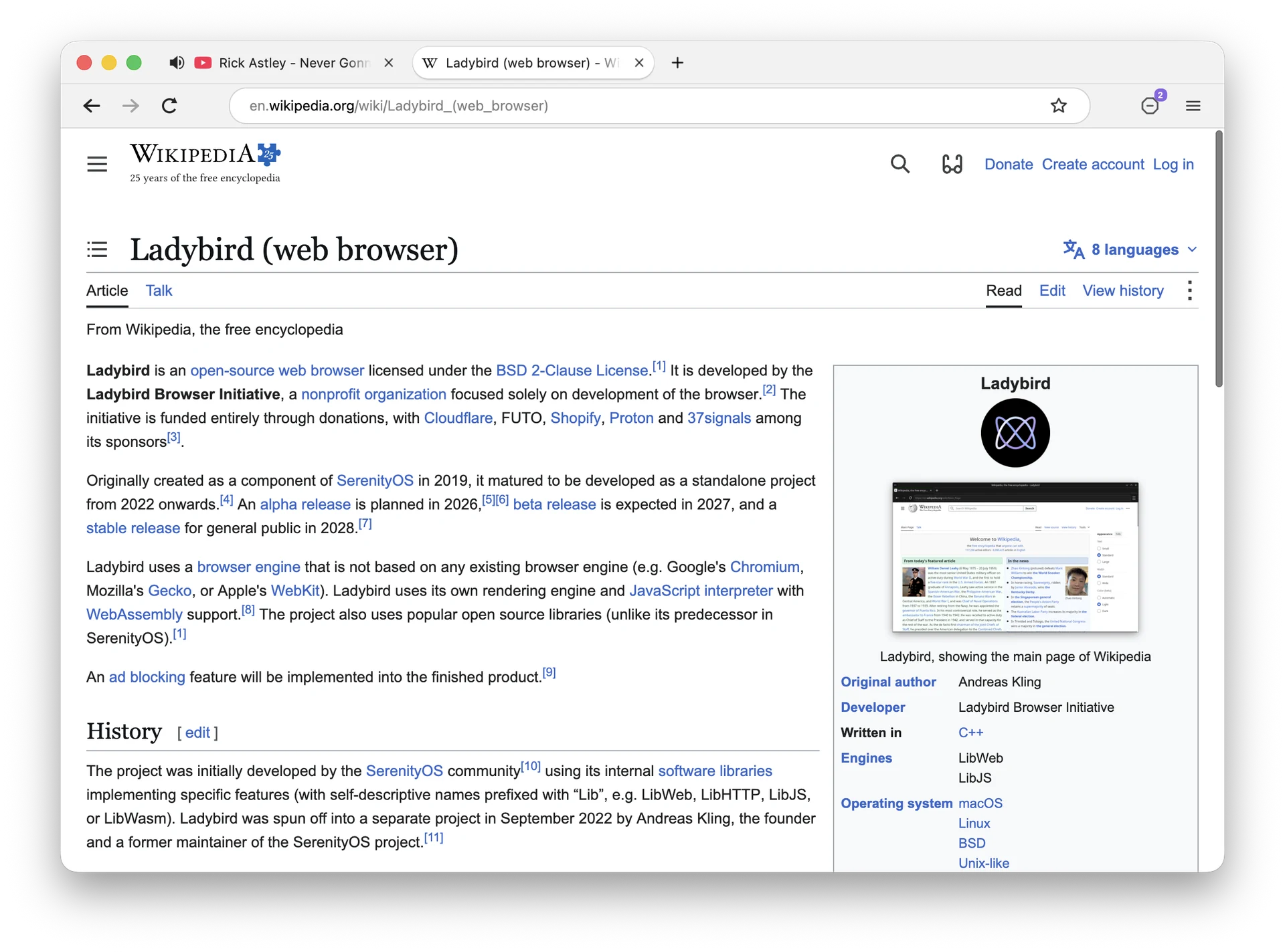
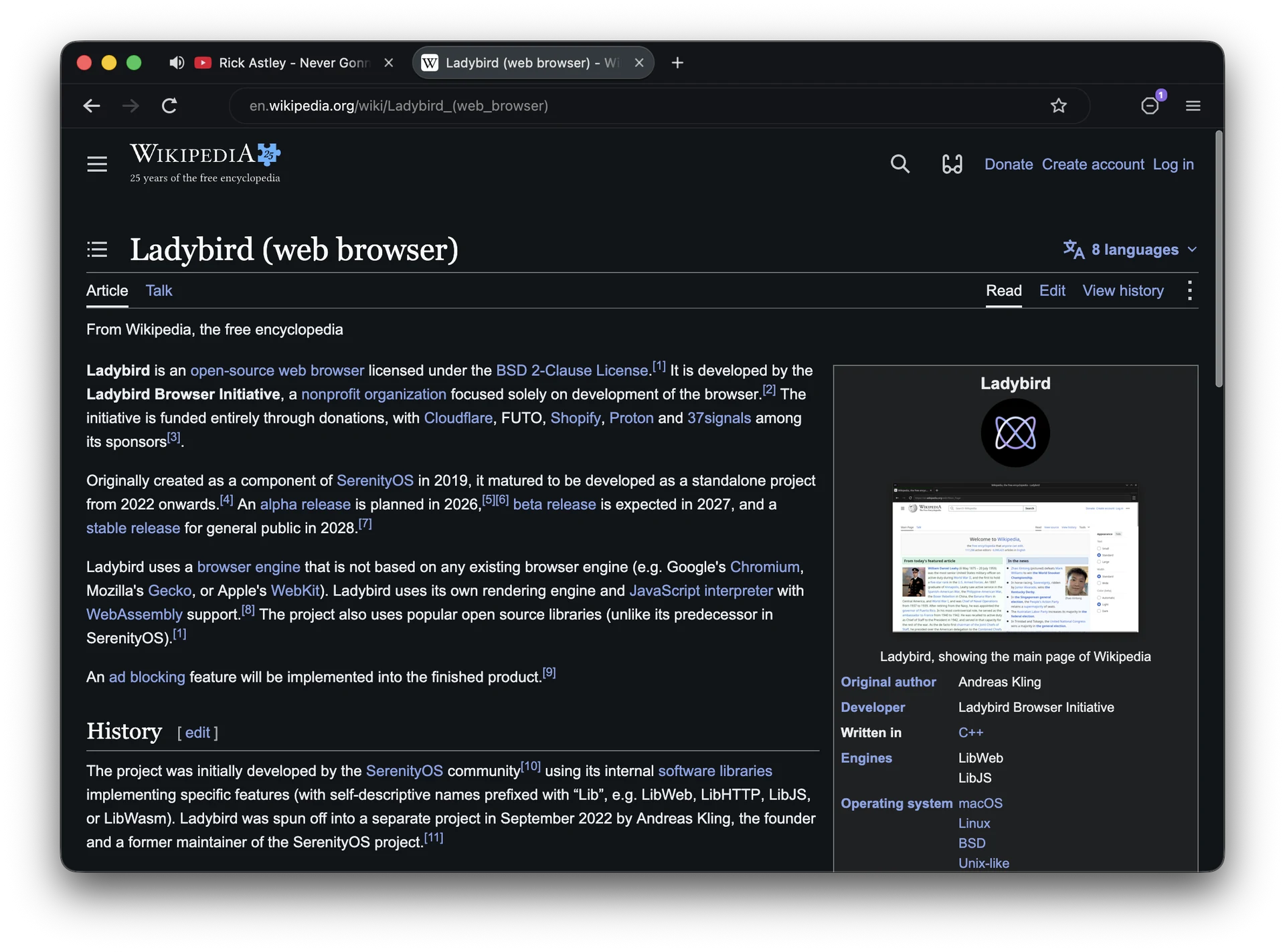
About
The web is the most important platform in computing, yet only a small number of browser engines power the entire thing, each controlled by a company with its own agenda.
Ladybird is built on web standards and free from conflicts of interest.
What makes Ladybird different
-
Independent
A new engine written from scratch. Not a fork of Chromium, Gecko or WebKit.
-
Just a browser
We build a web browser, and nothing else.
-
No monetization
No "default search deals", crypto tokens, or other forms of user monetization.
News
Security hardening with Trail of Bits, costly idle pages, smoother animation, hardware video decoding, and more of the web working in Ladybird.
Video on Twitch and YouTube, CSS scroll snap, JavaScript debugging, session restore, and a serious push on engine performance with a new style engine.
Private browsing, browser profiles, undo/redo, geolocation, WebAudio, a faster compositor, and moving style and layout to Rust.
Download management, sandboxing, browsing history, DevTools storage inspection, media playback speed, GPU isolation, WebAssembly GC, and more.
Ladybird is changing how code enters the project as we prepare to ship a browser to real users.
Passing Cloudflare Turnstile, async scrolling on an out-of-process compositor, Media Source Extensions on by default, a WebAssembly JIT, native content blocking, the HTML parser in Rust, on-disk JS bytecode cache, CSS @container/@scope/subgrid, and more.
Get involved
Ladybird is open source, developed by a small team in the open. You can help by filing bug reports, creating reductions, testing websites, reporting security issues, and sharing technical feedback.
You can clone the code and run Ladybird locally. On many development machines it is as simple as this:
$ git clone https://github.com/LadybirdBrowser/ladybird.git
$ cd ladybird
$ ./Meta/ladybird.py run
For more detailed, operating-system-specific information, check out our full build instructions. For more about how Ladybird development works, see Changing How We Develop Ladybird.
Sponsors
Platinum





Gold



Silver





Bronze















Copper
Travis Heinström Sjors Witteveen b1ack0wl Gian Giovani Timely Learning Coursiv Andrew Mead styfle Tyler Horvath Hnefatafl Org Softwired Technologies Zain Allarakhia zacoons Jakub Stęplowski wheelofnames.com All Things Secured publicqi
Infrastructure Sponsors




Support the project
Ladybird is funded entirely by donations and sponsorships.
Become a sponsor
Sponsors are recognized on our website and in project updates. Sponsorships run for one year.
| Platinum | $100,000 |
| Gold | $50,000 |
| Silver | $10,000 |
| Bronze | $5,000 |
| Copper | $1,000 |
For sponsorship inquiries, email contact@ladybird.org.
Individual donations
One-time or recurring monthly donations via Donorbox.
DonateFor larger donations, please contact us directly to avoid processing fees.
Frequently asked questions
When is it coming?
Our first Alpha for macOS and Linux is coming later this year. It will be aimed at developers and early adopters.
How many people are working on the browser today?
We have a small full-time engineering team working on Ladybird, supported by community testing, bug reports, security reports, and technical feedback.
What's the hiring plan?
Our team size is stable for now. We will revisit hiring as the project's needs evolve.
We will strive to maintain 18 months of runway at all times.
What do you mean by "not a fork of an existing engine"?
The focus of the Ladybird project is to build a new browser engine from the ground up. We don't use code from Blink, WebKit, Gecko, or any other browser engine.
For historical reasons, the browser uses various libraries from the SerenityOS project, which has a strong culture of writing everything from scratch. Now that Ladybird has forked from SerenityOS, it is no longer bound by this culture, and we make use of 3rd party libraries for common functionality (e.g. image/audio/video formats, encryption, graphics, etc.), including some of the same libraries used by other browsers.
Will Ladybird work on Windows?
Our CI already builds and tests the JavaScript engine on Windows. Full browser engine support on Windows will follow in time.
Our full-time engineers are currently focused on macOS and Linux, with Windows support planned for a later stage of the project.
Will Ladybird work on mobile devices?
Mobile platforms are not a current focus. More effort will be put into Android and iOS once the desktop versions are in a good state.
How can you be "independent" if you have sponsors?
All sponsorships are in the form of unrestricted donations. Board seats and other forms of influence are not for sale, and sponsors have no say in our technical roadmap or product direction.
Why build a new browser in C++ when safer and more modern languages are available?
Ladybird began as part of SerenityOS, a C++ project, so the codebase started and largely remains C++. We have since adopted Rust as our C++ successor language and are incrementally porting subsystems to Rust. See our announcement post for more details.