
Hello friends! In July Ladybird gained private browsing, browser profiles, undo/redo, geolocation, and working WebAudio. Under the hood, we moved our style system and layout engine over to Rust.
Sponsors
Ladybird is entirely funded by companies and individuals who believe in the open web. You can see everyone currently supporting the project on our sponsors page, and we’re grateful to all of them. If you’re interested in sponsoring, please contact us.
Private browsing
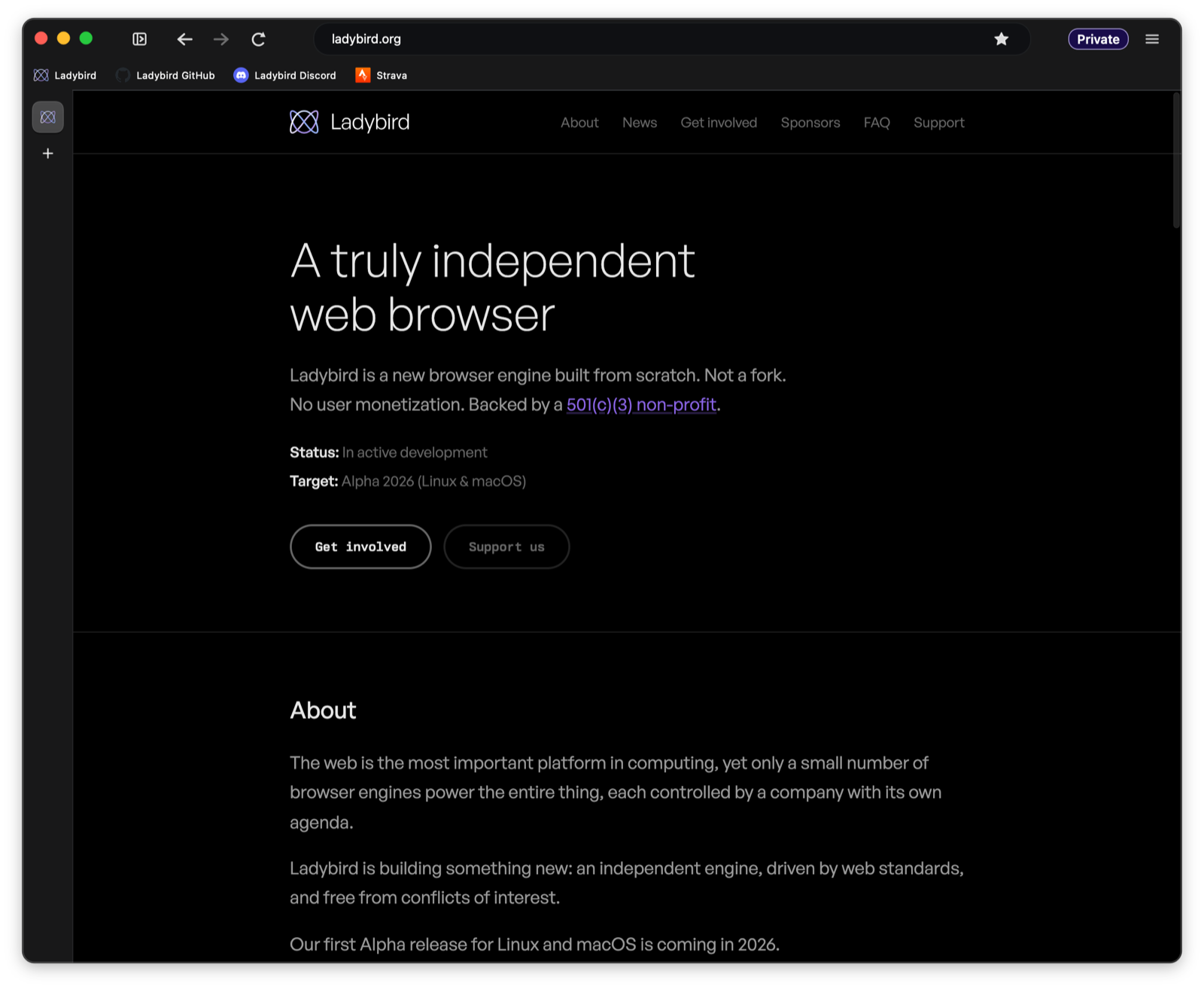
Ladybird now has private browsing windows (#10469, #10564). Cookies, storage, history, caches, downloads and address bar suggestions are all routed by privacy, and a page process is only ever wholly private or wholly normal.
Browser profiles
Everything Ladybird stores now lives inside a profile (#10663). A profile owns its own settings, bookmarks, history, cookies and site storage, HTTP caches, etc.
There’s a default profile that we use unless you specify otherwise:
ladybird                          # uses the `default` profile
ladybird --profile work           # a named profile, kept between runs
ladybird --temporary-profile      # a fresh one, deleted on exit
Profiles can run side by side, and the sandbox rules for helper processes are generated per profile so each one can only reach its own files. Launching a profile that’s already running hands the URL to the existing window instead of starting a second copy. On macOS they get distinct Dock badges so you can tell them apart (#10665).
Undo/redo and rich text
Undo/redo now works for editing in contenteditable and text controls, wired up to the Edit menu with the usual shortcuts (#10758). Copy and paste preserves styled text, images, lists and paragraphs (#10770), and the clipboard shortcuts now fire real copy, cut and paste events, which is how editor frameworks implement clipboard support (#10632). Cursor movement also follows visual lines, so the arrow keys behave in wrapped text (#10517).
Editing is one of the least specified corners of the web platform. Nothing written down tells you how many keystrokes should collapse into a single undo step, so the only way to be interoperable is to match what shipping engines already do. We built our expectations by running a giant editing test through other browsers and recording the DOM and cursor positions they ended up with. Fuzzing editing sequences against it turned up several divergences plus a crash of our own.
Geolocation
Ladybird can answer geolocation requests, using CoreLocation on macOS and Qt Positioning on Linux (#9737). It denies location by default until we have a real permissions system, so for now it’s opt-in from settings.
WebAudio
WebAudio gained offline and real-time rendering (#10823, #10780), which is enough to make audio work on Slow Roads, Faster Than Light, and a WebAssembly build of Doom 3.
WebAssembly
WebAssembly got substantially faster this month. The common cases for calls now happen directly instead of going out to a helper, which is worth 20x to 50x on call microbenchmarks (#10719). More operations moved inline for the same reason (#10783).
Here’s Shopify’s Horizon Drive running in Ladybird. The engine, the music, and the sparks when I scrape along a wall are all WebAudio. :^)
Browser UI
- Omnibox : when history suggestions changed while you were typing, pressing Enter would sometimes submit the prefix you had typed instead of the completion shown in the bar. Location bar editing is now a single state machine, so pressing Enter always acts on the text being displayed (#10409, #10633). It also learns which result you pick for a given input (#10742), and there’s a “Paste and Go” menu item (#10853).
- You can now press Esc to stop an ongoing page load (#10615).
- Right-clicking URL-like text gives you the link menu, selecting the URL for you the way Safari does (#10523).
- Downloads : Links with the
downloadattribute now download instead of navigating, using the filename they ask for (#10777), clearer progress counters (#10820), and a downloads popover on macOS (#10454). - New tabs open next to the tab that spawned them (#10528).
- The screen stays awake while a video plays, on macOS for now (#10066).
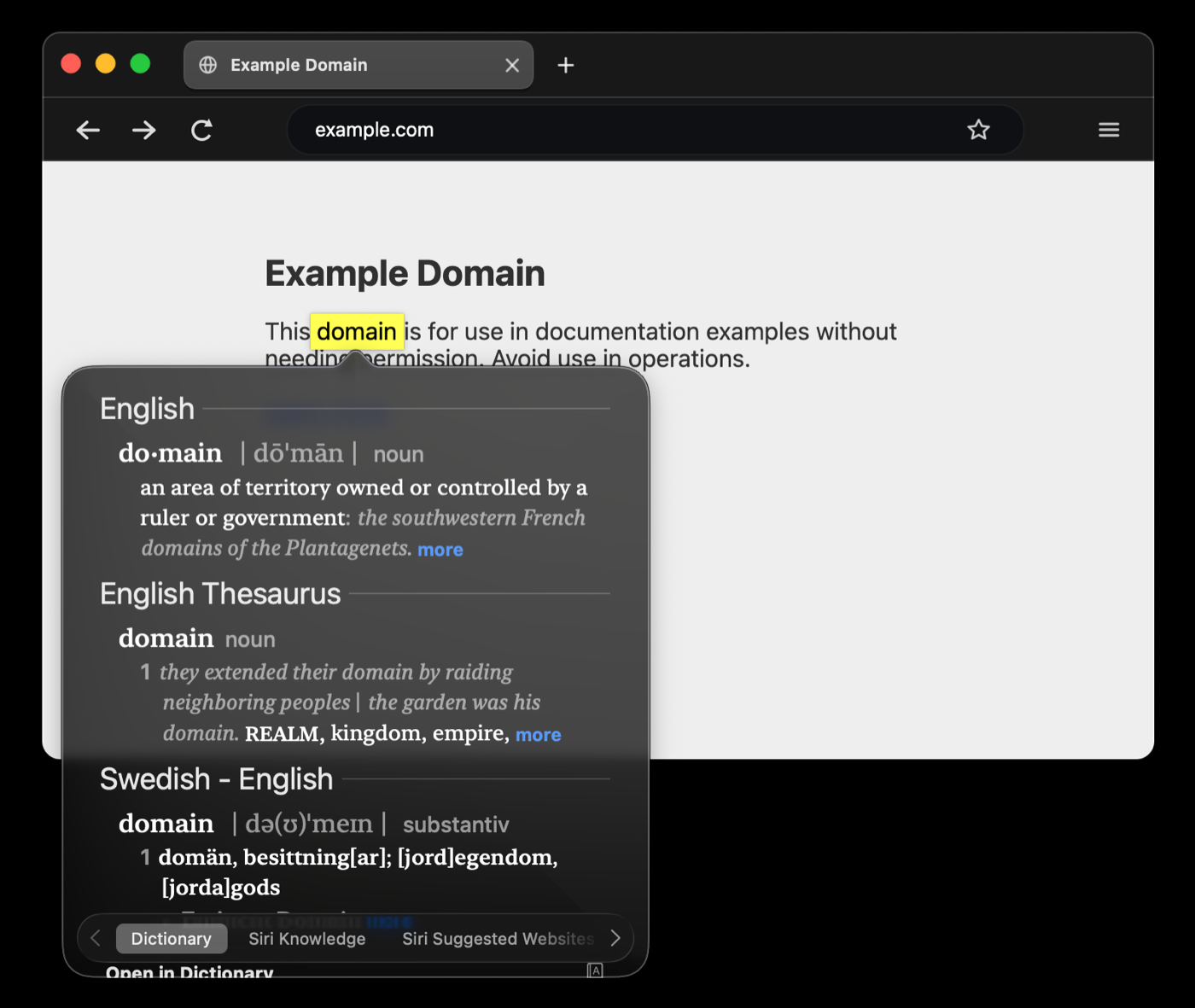
- macOS dictionary lookup , from the context menu or Force Touch (#10541).
DevTools
You can now launch the Firefox DevTools client straight from Ladybird, instead of starting our server and connecting by hand (#10707). Network request details got filled in too (#10704). (Note: we’re using the Firefox DevTools and their protocol as a stopgap until we have our own.)
CSS
- Relative colors from CSS Color 5, for
rgb(),hsl(),hwb(),lab(),oklab(),lch(),oklch()andcolor()(#10389). This is what Discourse-based forums were checking for when they reported Ladybird as unsupported (#10280). - Custom functions :
@functionevaluation (#10512, #10801). - Style queries :
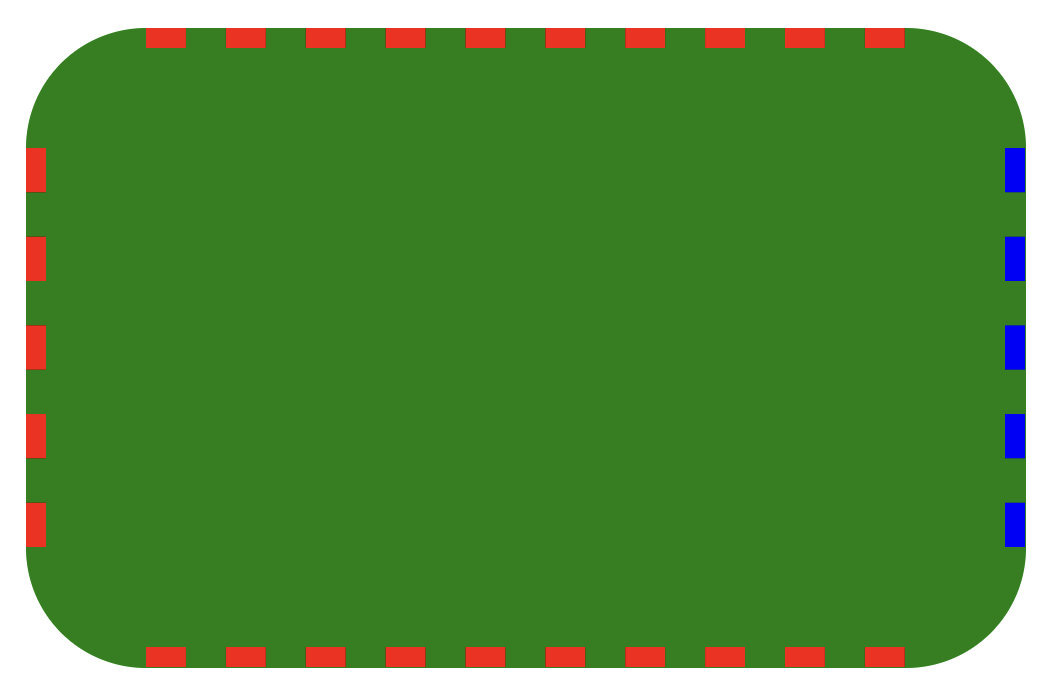
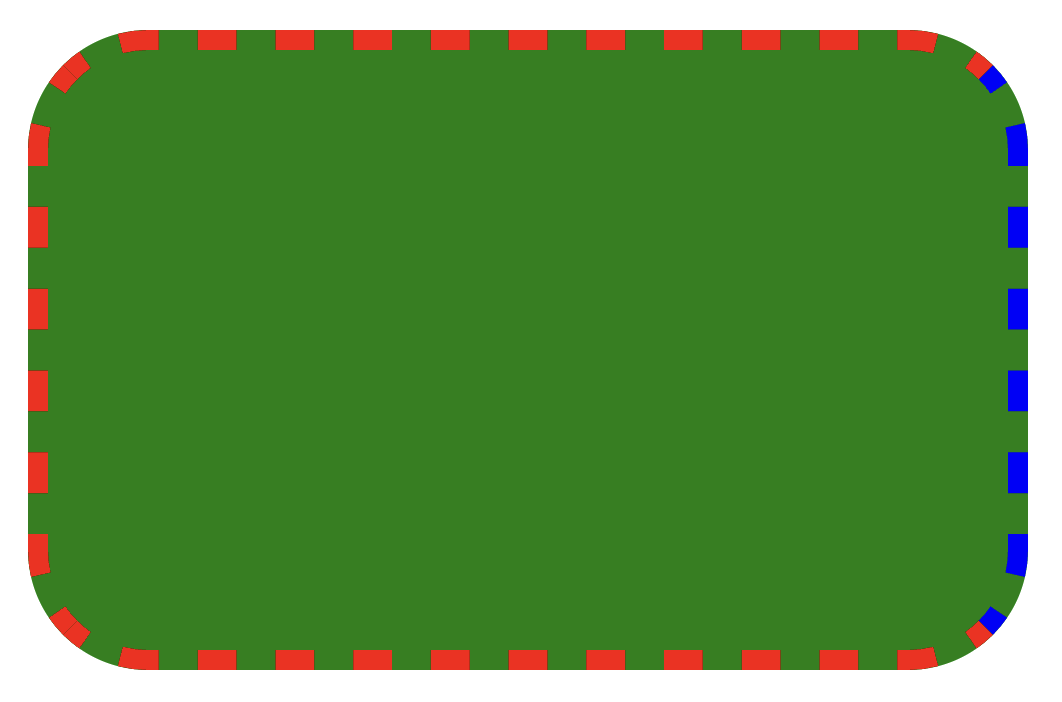
if(style())(#10383),<style-range>conditions (#10405) and@container style()(#10701). - Dashed and dotted rounded borders are drawn around the curve instead of giving up at the corners (#10898).
| Before | After |
|---|---|
 |  |
Text rendering
Text on Linux had uneven letter spacing because we ignored fontconfig’s hinting settings. We now follow them (#10579, #10344).
| Before | After |
|---|---|
 |  |
The system-ui font family also resolved to generic sans-serif outside macOS, rather than the font your desktop actually uses for its own interface. We now ask the toolkit (#10604).
Sites that work better
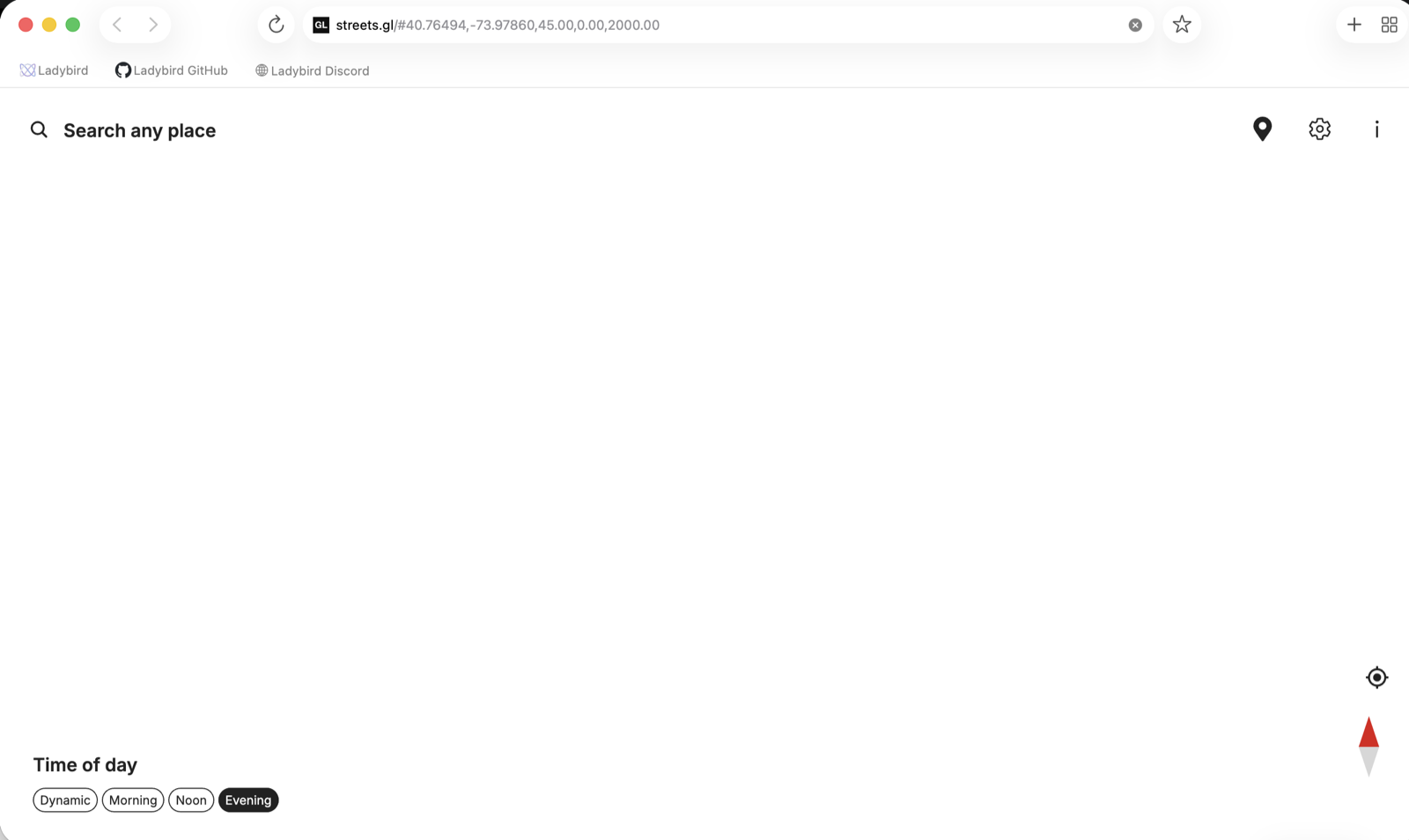
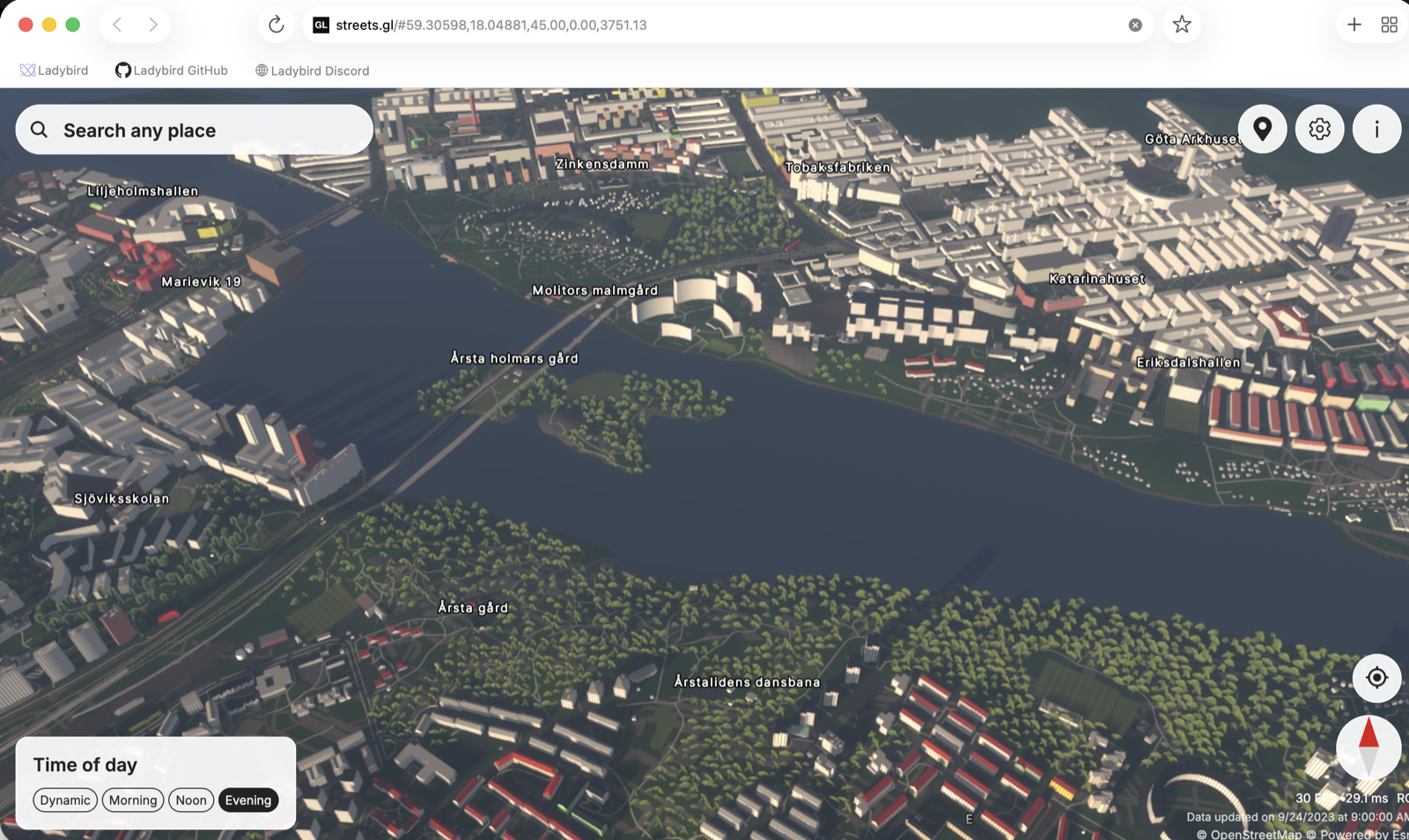
streets.gl renders a 3D city from OpenStreetMap data, and it had been a white page for us since July 2024 (#697). Fixing it took 3D texture uploads from images, a couple of WebGL extension queries that were answering with the wrong shape of value, and mostly not falling over when a page hands us more textures at once than we have file descriptors to ship them with (#10411).
| Before | After |
|---|---|
 |  |
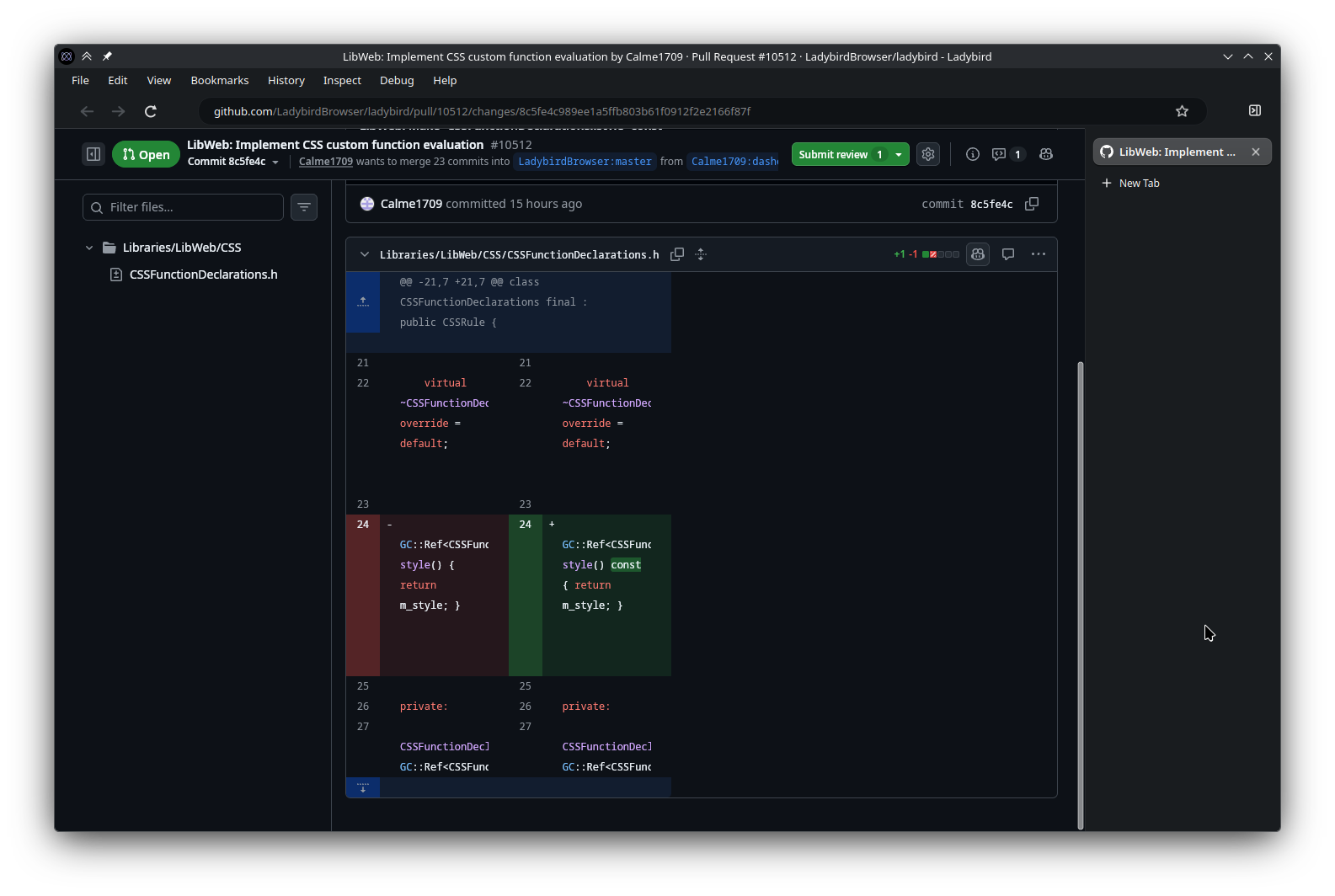
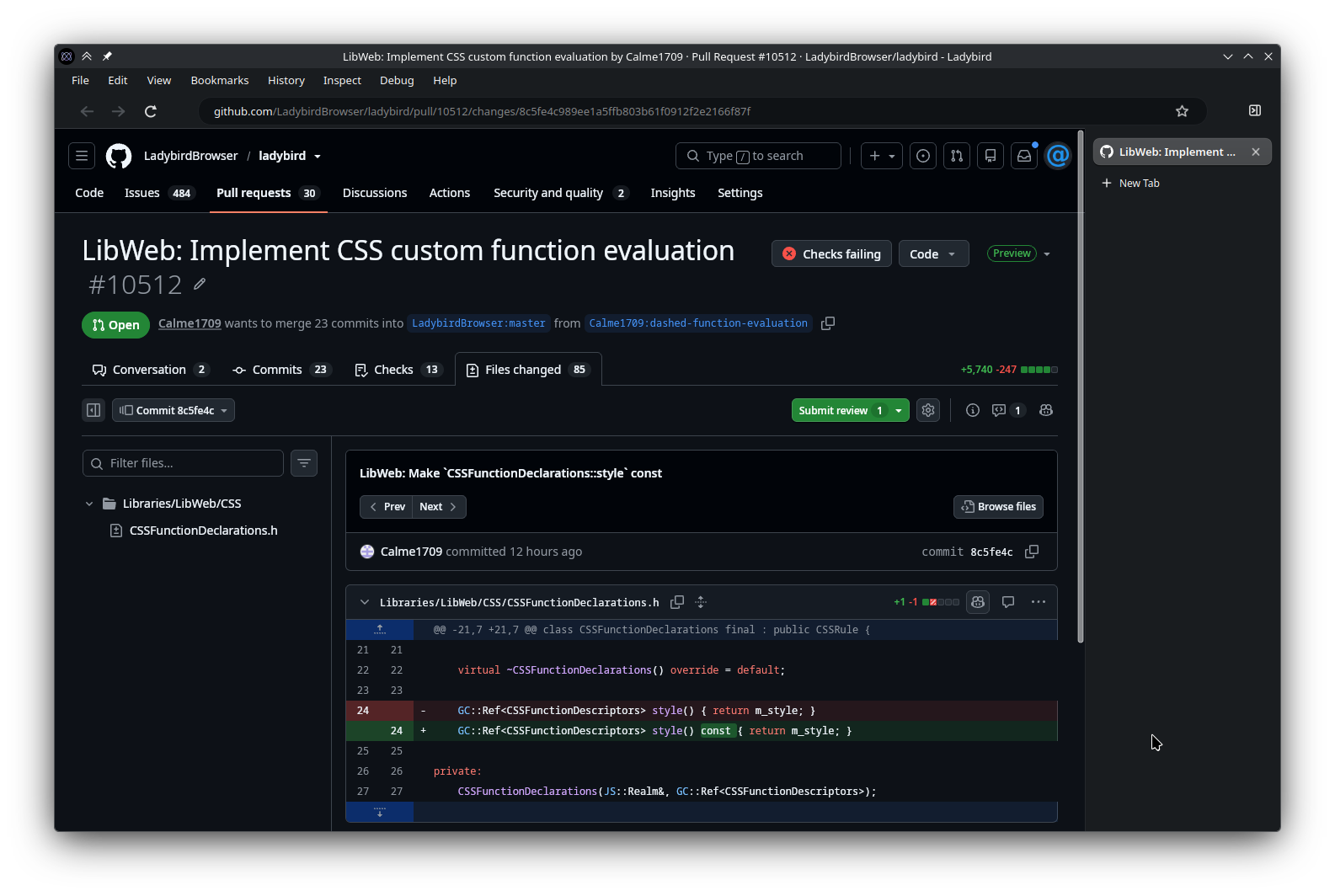
GitHub’s code review page : several table layout fixes cleaned up the diff view (#10561, #6598).
| Before | After |
|---|---|
 |  |
A few more:
- X.com : a cluster of
contenteditablefixes for problems the composer exposed (#10513). - chatgpt.com : much less redundant style work, which makes streaming responses smoother (#10596).
- kronansapotek.se : three engine bugs around CSS animations and the top layer, found while investigating this site (#10595).
- rituals.com : a crash and a lot of load-time jank, both triggered by the site throwing away its server-rendered DOM (#10723).
A faster compositor
- Choosing which video frame to show moved into the compositor, which buys playback a few frames of slack when the page is busy (#10509). Sustained jank will still stall it.
- We now repaint only the parts of the screen that changed, instead of the whole viewport (#10617).
- WebGL commands are passed via shared memory instead of being copied on every flush, which on texture-heavy pages used to eat up to 40% of the page process’s main thread. It’s now around 6% (#10720).
- Smooth scrolling runs on the compositor, so scrolling stays smooth while the page is busy (#10794).
A typed language for our JavaScript interpreter
The inner loop of our JavaScript engine is a low-level interpreter, with one handler per bytecode instruction, 183 of them before this work. Here’s BitwiseXor (the ^ operator) in the assembly dialect we used before. Most of it is shorthand: load_binary_operands and coerce_to_int32s are macros of their own, and the rest are language built-ins, not machine instructions.
handler BitwiseXor
    temp lhs, rhs, lhs_int, rhs_int, dst
    load_binary_operands lhs, rhs
    coerce_to_int32s lhs, rhs, lhs_int, rhs_int, .slow
    xor lhs_int, rhs_int
    box_int32 dst, lhs_int
    store_operand m_dst, dst
    dispatch_next
.slow: @cold
    call_slow_path asm_slow_path_bitwise_xor
end
That approach works, and those names are symbolic, not real machine registers, since the old generator assigned those for us. But nothing knew that lhs_int holds an integer, nothing checked that a value was written before it was read, and the interesting decisions were buried inside macros like coerce_to_int32s. The generator also did no optimization, so every redundant load in the source became a redundant load in the interpreter.
So we built a typed language to write the interpreter in, along with a compiler that turns it into x86-64 and AArch64 at build time (#10867). It’s called “flap”, after the sound of a ladybird’s wings. :^) The same handler now:
handler BitwiseXor(dst: out Operand, lhs: in Operand, rhs: in Operand) {
    let lhs = load(lhs);
    let rhs = load(rhs);

    let slow = || @cold {
        call_binary_slow_path(bitwise_xor_values, dst, lhs, rhs);
    };

    let non_int32 = || @cold {
        guard let lhs_integer = numeric_value_to_i32(lhs) else slow;
        guard let rhs_integer = numeric_value_to_i32(rhs) else slow;
        xor(lhs_integer, rhs_integer);
        store(dst, box_i32(lhs_integer));
        dispatch_next;
    };

    guard let Value<i32>(lhs_integer) = lhs else non_int32;
    guard let Value<i32>(rhs_integer) = rhs else non_int32;

    xor(lhs_integer, rhs_integer);
    store(dst, box_i32(lhs_integer));
    dispatch_next;
}
Now the types are checked, the compiler proves every value is written before it’s read, and it optimizes what it emits, while we still get to say exactly what the machine code should look like. (Making sure the right values are in CPU registers at the right time is absolutely essential here!)
The interpreter is laid out in two halves. The typical execution path goes in a “hot” section: Int32 arithmetic, no exceptions. Anything unusual is lifted out into a “cold” section far away in the binary, and the hot path jumps over there only when it has to. Those @cold closures above are the two ways this handler can leave the fast path, and neither costs anything on the fast path itself. BitwiseXor’s hot path is 19 instructions, while its cold half is another 57. Every handler is split this way, so running ordinary JavaScript only touches the hot fraction of the interpreter, and that fraction is small enough to stay in instruction cache.
Switching over was performance-neutral, which is what we wanted from it. The gains came afterwards, some from things the old dialect had no way to express. This one line is a complete description of a new instruction, specialized for when the right-hand side is a known 32-bit integer (#10923):
specialize BitwiseXor(rhs: Int32);
The compiler works out the specialized handler and the code that selects it, and the BitwiseXor above stays the only place describing what xor means. Here’s what it does to the generated code. The generic hot path again, 19 instructions:
    mov ecx, DWORD PTR [r14 + r13 + 8]   # read lhs slot number from the bytecode
    mov eax, DWORD PTR [r14 + r13 + 12]  # read rhs slot number from the bytecode
    mov rsi, QWORD PTR [rbx + rcx * 8]   # load the lhs value
    mov rdx, QWORD PTR [rbx + rax * 8]   # load the rhs value
    mov rax, rsi                         # \
    shr rax, 48                          #  | is lhs an Int32?
    cmp ax, 32762                        # /
    jne .Lasm_BitwiseXor.ssa_block_2     # no: off to the cold section
    mov r11, rdx                         # \
    shr r11, 48                          #  | is rhs an Int32?
    cmp r11w, 32762                      # /
    jne .Lasm_BitwiseXor.ssa_block_2     # no: off to the cold section
    xor esi, edx                         # xor them
    or rsi, r15                          # tag the result as an Int32
    mov r11d, DWORD PTR [r14 + r13 + 4]  # read dst slot number from the bytecode
    mov QWORD PTR [rbx + r11 * 8], rsi   # store the result
    add r13d, 16                         # advance past this instruction
    movzx eax, BYTE PTR [r14 + r13]      # read the next opcode
    jmp [r12 + rax * 8]                  # jump to its handler
And the specialized one, 14 instructions:
    mov eax, DWORD PTR [r14 + r13 + 8]        # read lhs slot number from the bytecode
    mov rdx, QWORD PTR [rbx + rax * 8]        # load the lhs value
    mov eax, DWORD PTR [r14 + r13 + 12]       # read the constant from the bytecode
    mov r11, rdx                              # \
    shr r11, 48                               #  | is lhs an Int32?
    cmp r11w, 32762                           # /
    jne .Lasm_BitwiseXorRhsInt32.ssa_block_2  # no: off to the cold section
    xor edx, eax                              # xor them
    or rdx, r15                               # tag the result as an Int32
    mov r11d, DWORD PTR [r14 + r13 + 4]       # read dst slot number from the bytecode
    mov QWORD PTR [rbx + r11 * 8], rdx        # store the result
    add r13d, 16                              # advance past this instruction
    movzx eax, BYTE PTR [r14 + r13]           # read the next opcode
    jmp [r12 + rax * 8]                       # jump to its handler
The right-hand side never comes out of the register file, and the type check for it is gone completely, because the number is sitting right there in the bytecode. We use the same mechanism for the Int32 arithmetic, the shifts and the comparisons, and to fuse common instruction pairs into one. So far it’s worth around 5% on some of the more compute-heavy JS benchmarks.
Moving style and layout to Rust
This month we moved much of LibWeb’s style and layout pipeline to Rust. This is progress on our goals for using safe languages in the codebase, and it also unlocks some very tasty opportunities for parallelism. Style and layout both do a lot of repeated work over large trees, and it’s work that could be spread across cores, but that’s the kind of change that’s a lot more comfortable to wrangle when the language can stop two threads from stepping on each other. Style is now stored as immutable, shared values that Rust owns, which is the substrate parallel restyling needs, and layout can read it directly rather than pulling it back out of C++.
A big chunk of it landed in July. Selector matching went first (#10731, #10795), followed by computed style, the cascade, animations and calc() (#10772, #10861, #10787), then layout tree construction (#10838) and every formatting context we have, block through SVG (#10901).
This isn’t finished yet. Parts of style and layout still call back into C++, and CSS parsing, the DOM and painting haven’t moved at all. But the bulk of the move is behind us.
Caging ArrayBuffers and Wasm memory
Almost every exploit anyone has demonstrated against Ladybird to date has used ArrayBuffer. Once you got control of its data pointer, you could use it to read/write all memory in the process. It was an amazingly convenient exploit primitive!
This month we’ve made it a lot less convenient: ArrayBuffer contents and WebAssembly memories now live inside one reserved 4 TiB region of address space, and every access is forced to land inside it (#10391). An out-of-bounds access is still a bug, and it can still reach other buffers inside the cage, but it can no longer reach the objects, stacks and code outside it.
Web Platform Tests (WPT)
Our WPT score went from 2,078,912 to 2,079,020 this month, a gain of 108 subtests. No major movement here, as expected given the nature of most of this month’s work.
Other notable changes
- Windows : we stopped pretending Windows is POSIX (#10489), and rendered frames now reach the GPU without a copy, matching macOS and Linux (#10834).
- Brotli is supported for
CompressionStreamandDecompressionStream(#10355). - The Gtk port is gone . We’re focusing our efforts on making the Qt port look solid everywhere instead (#10536).
That’s it for July. Step by step, we’re getting closer to our first alpha. Thanks for reading, and we’ll see you next month!